

| Markets in 2025 were largely resilient despite volatility from geopolitics, trade tensions and tariff shocks | Trump’s Liberation Day trade announcements in April drove a sharp sell-off, but markets later rebounded | Rachel Reeves’ Budget underscored a difficult domestic backdrop, with tax rises of £26bn announced |
Equity markets in 2025 have been impacted by a mix of competing forces. Geopolitical tensions and evolving US trade policies have sparked short periods of volatility, while supportive fiscal policy, easier monetary conditions, solid corporate earnings and continued enthusiasm for AI have bolstered markets, providing a resilient economic backdrop… but it hasn’t all been smooth sailing.
The World Economic Forum (WEF) in Davos (January 2025) was dominated by discussion about the global implications of Donald Trump’s return to the White House – particularly his stance on tariffs, deregulation and energy policy. WEF President and CEO Børge Brende noted, “We are at an inflection point,” saying that the event was taking place during “one of the most uncertain geopolitical and geoeconomic moments in generations.”
The Annual Meeting coincided with Trump’s inauguration, and on day four the newly sworn-in President addressed global CEOs virtually, setting out the priorities for his second term, saying, “Under the Trump administration, there will be no better place on Earth to create jobs, build factories, or grow a company than right here in the good old USA.”
Ngozi Okonjo-Iweala, Director General of the World Trade Organization urged fellow delegates, “Don’t hyperventilate – let’s keep calm and see what will actually happen.” And as Q1 progressed, while European markets outperformed on expectations of higher defence spending and hopes for a de-escalation of the Russia-Ukraine conflict, US equities came under pressure amid rising concerns about trade tensions and fiscal management. As Trump’s presidency embedded – we didn’t have to wait long for…
“A little tough love”
Donald Trump was the key factor shaping global affairs in 2025, this won’t change in 2026. Liberation Day trade traumas had a far-reaching impact back in April. It all kicked off with one “big, beautiful chart” featuring tariff increases for countries around the world, including 34% China, 20% EU, 49% Cambodia, UK 10%. Trump made it clear he was no longer allowing imports into the US without an appropriate tariff, saying countries should embrace “a little tough love.”
The market fallout was immediate. The futures markets crashed, with the S&P 500 losing $2trn in market capitalisation in under 20 minutes. The S&P 500 fell more than 10% in just three days. Global indices traded sharply lower as investors sought safety in gold and bonds. European Commission Chief Ursula von der Leyen said the policy would produce “dire” consequences for people around the world, adding there was “no clear path through the complexity and chaos.”
Days later, President Trump softened his approach, announcing a 90-day pause in the implementation of tariffs, giving countries a chance to enter into negotiations with the US.
The rebound
Following the sharp sell-off in global equity markets around Liberation Day, we have seen a strong and broad-based recovery. Volatility in late April and early May reflected a combination of concerns, from trade tensions and geopolitical risks to tighter financial conditions amid rising bond yields. The subsequent rebound through Q2 and into H2 was fuelled by a mix of macroeconomic resilience, shifts in policy expectations as Trump softened his stance, trade negotiations, renewed expectations of rate cuts, and a robust earnings season; with AI-driven earnings growth, particularly among US mega-cap tech companies, dominating.
This chart of the MSCI World Index shows the market rebound since Liberation Day (2 April 2025)
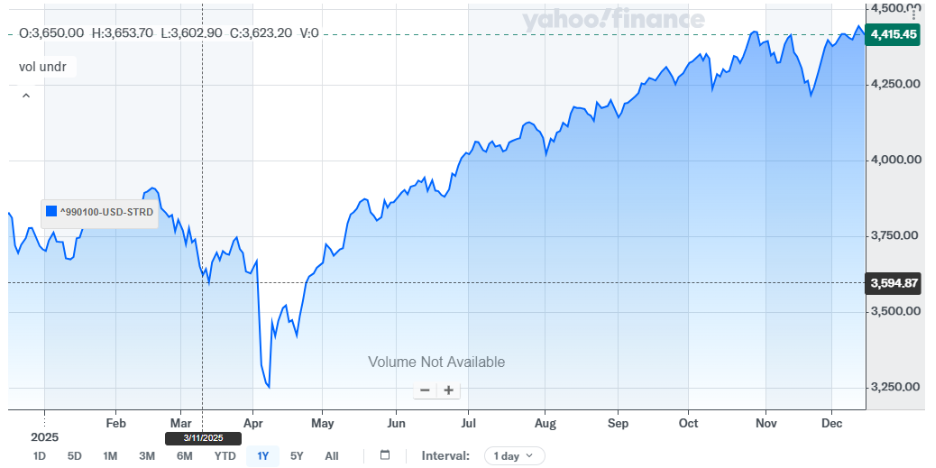
The MSCI World Index is a globally recognised equity benchmark, representing the performance of large and mid-cap stocks across developed markets
“What we are seeing is demonstrable resilience in the world”
The International Monetary Fund’s (IMFs) latest World Economic Forecast entitled, ‘Global economy in flux, prospects remain dim,’ shows projections have been revised upward from the spring forecast but continue to mark a downward revision. Global growth is projected to slow to 3.2% in 2025 and 3.1% in 2026, with advanced economies growing around 1.5% and emerging market and developing economies just above 4%. Inflation is projected to continue to decline globally, though wide variation across countries exists.
In October, IMF Managing Director Kristalina Georgieva said, “All signs point to a world economy that has generally withstood acute strains from multiple shocks… What we are seeing is demonstrable resilience in the world… we are also saying it is a time of exceptional uncertainty and downside risks are still dominating the forecast.”
IMF cites that downside risks to growth include prolonged uncertainty, more protectionism and labour supply shocks, while stability is threatened by fiscal vulnerabilities and potential financial market corrections. IMF urges policymakers to restore confidence through credible, transparent and sustainable measures – strengthening trade diplomacy, restoring fiscal buffers and safeguarding central bank independence.
For the UK, IMF predicts growth of 1.3% in 2025 and 2026. Although revised up from April estimates, reflecting an improvement in the external environment, including the UK-US trade deal announced in May, the projected growth is still lower than October 2024 forecasts.
A Klarna Budget – ‘Spend now, pay later’
At home, 2025 proved a challenging year for the government. Sir Keir Starmer’s tenure has been turbulent, with Labour’s promise of growth slow to materialise. Stubborn inflation, high living costs and weak economic momentum have left many households feeling worse off, while long-standing pressures in public services limited visible progress. Global uncertainty and tight fiscal conditions certainly added to the challenge.
Rachel Reeves’ 26 November Budget – labelled the ‘Klarna Budget’ – underscored this difficult backdrop, with tax rises of £26bn announced. The Institute for Fiscal Studies notes that the Chancellor is relying heavily on back-loaded tax hikes and increased medium-term borrowing – hence the moniker: spend now, pay later.
Bank Rate has been gradually cut throughout the year, as the Bank of England (BoE) weighs inflation trends against economic softness. BoE forecasts inflation will remain above its 2% target until Q2 2027.
Looking ahead, 2026 is shaping up to be a year of political insurgents, with May’s local elections likely to be a telling barometer. It also marks the tenth anniversary of the Brexit referendum and the five-year review of Boris Johnson’s Trade and Co-operation Agreement – ensuring Brexit re-enters the national conversation. With polls showing over 56% now viewing Brexit as a mistake, the government is pursuing steps to ease trade frictions by aligning with EU food standards and adopting shared energy and environmental rules.
In a historic moment for the London Stock Exchange, the FTSE 100 Index surged past the 9,000-point mark for the first time ever on 15 July 2025, setting a new all-time high.
The value of investments can go down as well as up and you may not get back the full amount you invested. The past is not a guide to future performance and past performance may not necessarily be repeated. It is important to take professional advice before making any decision relating to your personal finances. This document does not provide individual tailored investment advice and is for guidance only.
All details are believed to be correct at time of writing – 05 December 2025.